Winning Pathway® | Organizational Performance

The Problem You See May Not Be the Problem You Have.

When the same leadership, accountability, communication, culture, or execution problems keep returning, the visible symptom may be telling only part of the story.

Winning Pathway® helps senior leaders look beneath recurring organizational problems to uncover the human and systemic conditions interfering with performance—before deciding what actually needs to change.

Structured inquiry. Adaptive thinking. Evidence before prescription.

When the Problem Keeps Returning

You’ve tried to fix it. Why does it keep coming back?

Organizations rarely arrive at Winning Pathway® because no one has tried. More often, leaders have already invested significant time, money, and effort—and the same underlying problems continue to surface.

Leadership

You changed the leader.

Yet decision bottlenecks, trust problems, or operating tension continue under a different person.

Structure

You reorganized the teams.

Yet workarounds, unclear ownership, and coordination problems gradually reappear.

Development

You invested in training.

Yet the environment surrounding the new behavior still makes the desired change difficult to sustain.

Culture

You launched a culture initiative.

Yet what people experience every day still teaches them a different set of expectations.

Communication

You communicated the strategy.

Yet priorities fragment as they move through functions, leadership levels, and operating interfaces.

Policy

You revised the process.

Yet authority, relationships, incentives, expectations, or human behavior continue to work against the intended design.

When the intervention changes but the problem keeps returning, the next question should not automatically be “What else should we try?” It may be: “What are we missing?”
The Winning Pathway® Difference

What are we missing?

Winning Pathway® looks beyond the presenting symptom to examine the patterns, relationships, contradictions, human dynamics, organizational conditions, and evidence that may connect what initially appears unrelated.

Look Beneath

What does not fit?

We examine where leadership intention and organizational experience diverge, where expected behavior and actual conditions contradict one another, and where the visible problem may be masking something deeper.

Connect

What may be interacting?

Decisions, authority, relationships, culture, incentives, communication, history, leadership behavior, and organizational structure rarely operate independently.

Investigate

What does the evidence actually support?

Insight creates questions and hypotheses. Interviews, data, documents, assessments, stakeholder experience, context, and other relevant evidence help determine what is actually happening.

Identify

What matters most?

The objective is not to explain every organizational imperfection. It is to identify the conditions most consequential to performance and determine what should—and should not—be addressed first.

Patterns become easier to see when we stop treating every symptom as though it exists in isolation.
A Human-Systems Perspective

People affect systems. Systems affect people.

Organizational performance is shaped by the interaction between people, leadership, relationships, authority, structure, culture, communication, incentives, history, expectations, pressure, processes, and the environment in which work occurs.

Human System

What people experience and bring into the work.

Leadership behavior, judgment, trust, relationships, conflict, communication, identity, belonging, adaptability, experience, pressure, and the human realities that affect how people lead and work together.

Human +
System
Organizational System

What the organization makes easier—or harder.

Authority, structure, roles, decision rights, accountability, incentives, policies, communication flows, processes, expectations, operating relationships, and the architecture surrounding performance.

How Winning Pathway® Works

We do not begin with the solution.

Winning Pathway® provides a highly structured professional container while allowing the inquiry to follow what the evidence actually reveals. Different problems require different pathways.

Look Beneath

What is actually happening?

Clarify the presenting pressure without assuming that the visible symptom accurately identifies the source.

Connect

What appears related?

Identify patterns, relationships, contradictions, gaps, dependencies, and conditions that may be interacting across the organization.

Discern & Investigate

What deserves deeper examination?

Use insight to generate better questions, then investigate them through relevant evidence and organizational context.

Identify

What is most consequential?

Distinguish recurring symptoms from the conditions most meaningfully affecting organizational performance.

Re+Calibrate™

What actually needs to change?

Determine the intervention appropriate to what has been discovered— not what was assumed before the inquiry began.

Embed & Learn

How will healthier conditions hold?

Strengthen operating practices, accountability, leadership behavior, relationships, structure, or other relevant conditions over time.

Structured Container. Adaptive Thinking.

Non-formulaic does not mean unstructured. It means the investigation is disciplined enough to be credible and flexible enough to follow what the organization is actually revealing.

Flagship Diagnostic Entry

Before investing in another solution, understand what may actually be getting in the way.

The Executive System Assessment is a structured but adaptive organizational inquiry.

It brings together relevant evidence to help leadership distinguish the presenting problem from the conditions most meaningfully affecting performance—and determine the most appropriate next step.

Explore the Executive System Assessment
Where Organizational Transformation Happens

Behavior and architecture shape one another.

Winning Pathway® does not treat leadership behavior and organizational design as separate realities. Performance emerges from the interaction between the human system and the operating system around it.

Human System

What people experience, practice, and reinforce.

Leadership behavior, trust, communication, accountability, relationships, judgment, belonging, conflict, adaptability, and the patterns people learn are safe, rewarded, tolerated, or expected.
System
Fit
Where alignment becomes performance.
Operating System

What the organization structurally makes possible.

Roles, authority, decision rights, structure, processes, organizational interfaces, operating rhythms, information flow, resource allocation, accountability, and the architecture through which work gets done.

Organizational transformation becomes durable when the behavior expected from people and the system surrounding that behavior reinforce the same operating reality.
Recognition → Understanding → Re+Calibration™

Seeing the pattern is the beginning. Changing the conditions is the work.

Recognition gives leaders language for what is happening. Organizational transformation requires going further—understanding what is sustaining the pattern and changing the conditions that allow it to continue.

01 / RECOGNIZE

Name What Is Happening

Make recurring leadership, culture, communication, accountability, relationship, and performance patterns visible enough to examine rather than normalize.

02 / UNDERSTAND

Determine What Is Producing It

Examine the interaction between leadership behavior and organizational architecture to identify where the pattern is being reinforced or reproduced.

03 / RE+CALIBRATE™

Change the Conditions

Realign leadership practices, decision rights, accountability, relationships, structure, operating expectations, communication, and execution so the organization stops reproducing the same constraint.

Explore the Re+Calibration™ Methodology →
Organizational Re+Calibration™

Work at the level where the organization is being constrained.

Organizational transformation is scoped around the conditions affecting enterprise performance rather than around a predetermined workshop, training program, or isolated leadership intervention.

Decision Architecture

Authority, Escalation & Decision Flow

Clarify where decisions belong, where authority has become disconnected from responsibility, and why decisions repeatedly stall or escalate.

Leadership System

Executive & Leadership-Team Alignment

Strengthen how leaders establish direction, coordinate across boundaries, resolve competing priorities, and operate as an enterprise leadership system.

Accountability

Ownership, Expectations & Operating Clarity

Make responsibility easier to locate and align expectations, authority, ownership, and consequences around critical work.

Organizational Interfaces

Cross-Functional Coordination

Address friction where teams, functions, levels, or organizations must exchange information, authority, resources, and work.

Culture & Relationships

What the System Rewards and Reinforces

Examine how leadership practices, structural conditions, communication, and everyday operating realities shape trust, culture, belonging, and behavior.

Execution

Translate Direction Into Coordinated Action

Strengthen the conditions through which strategy, decisions, priorities, accountability, communication, and work move into reliable execution.

When Organizational Transformation Becomes Valuable

Recurring friction is information.

Transformation becomes increasingly important when the organization continues encountering the same performance conditions despite capable leadership, sustained effort, and repeated attempts to fix them.

01

The Same Problems Keep Returning

Previous initiatives create movement, but the underlying organizational condition eventually reappears.

02

Senior Leaders Are Carrying Too Much

Executives increasingly compensate for ambiguity, coordination gaps, unclear ownership, or unresolved structural friction.

03

Growth Has Outpaced the Operating System

Roles, authority, processes, leadership practices, or operating rhythms no longer fit the scale or complexity of the organization.

04

Restructuring or Integration Changed the System

New organizational boundaries, leadership relationships, responsibilities, or dependencies have not yet stabilized.

05

Alignment in the Room Is Not Becoming Alignment in Execution

Leaders agree on direction, but work fragments as priorities, authority, information, and accountability move through the system.

06

Culture and Operations Are Telling Different Stories

Stated values and leadership expectations are contradicted by what everyday systems actually reward, tolerate, or reinforce.
When several of these conditions are present at the same time, the question often shifts from “What should we fix?” to “What is the system producing?”
When Organizational Transformation Becomes Valuable

Recurring friction is information.

Transformation becomes increasingly important when the organization continues encountering the same performance conditions despite capable leadership, sustained effort, and repeated attempts to fix them.

01

The Same Problems Keep Returning

Previous initiatives create movement, but the underlying organizational condition eventually reappears.

02

Senior Leaders Are Carrying Too Much

Executives increasingly compensate for ambiguity, coordination gaps, unclear ownership, or unresolved structural friction.

03

Growth Has Outpaced the Operating System

Roles, authority, processes, leadership practices, or operating rhythms no longer fit the scale or complexity of the organization.

04

Restructuring or Integration Changed the System

New organizational boundaries, leadership relationships, responsibilities, or dependencies have not yet stabilized.

05

Alignment in the Room Is Not Becoming Alignment in Execution

Leaders agree on direction, but work fragments as priorities, authority, information, and accountability move through the system.

06

Culture and Operations Are Telling Different Stories

Stated values and leadership expectations are contradicted by what everyday systems actually reward, tolerate, or reinforce.

When several of these conditions are present at the same time, the question often shifts from “What should we fix?” to “What is the system producing?”
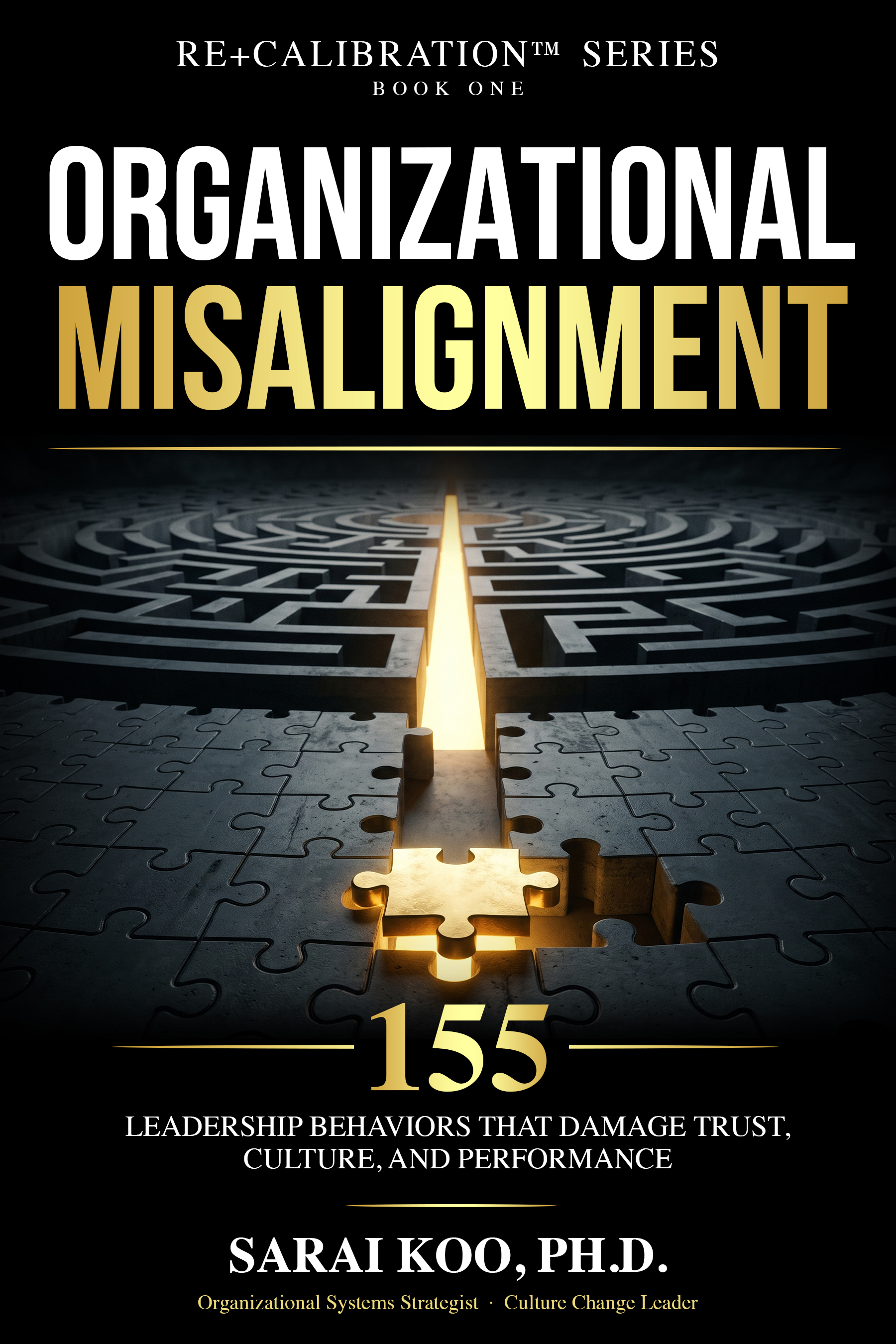
Organizational Misalignment by Sarai Koo, Ph.D.
Re+Calibration™ Series · Book One
The Intellectual Foundation | Organizational Misalignment

You cannot correct what the organization has learned not to see.

Organizational Misalignment gives leaders language for patterns that can become normalized long before they are recognized as system-level problems.

In Organizational Misalignment, Sarai Koo, Ph.D. examines 155 leadership behaviors across organizational systems—helping readers recognize patterns affecting authority, communication, culture, relationships, trust, and performance.

Winning Pathway® takes the organizational question further: once the pattern is visible, what leadership and operating conditions are allowing it to continue—and what must change for the organization to stop reproducing it?

The Book Recognize and name organizational misalignment.
Winning Pathway® Diagnose the system producing it.
Selected Evidence

Structural change should become visible in operating performance.

Selected Winning Pathway® engagements demonstrate what can happen when recurring friction is diagnosed at the level where work, decisions, relationships, and operating conditions actually intersect.

95%

Targeted Process Improvement

Documented improvement in a targeted federal operating process following structural diagnosis and redesign.

53.6%

Fewer Dysfunctional Steps

Reduction in dysfunctional or duplicative process steps after unnecessary operating friction was identified and removed.

92.5%

Increased Efficiency

Documented increase in efficiency within the targeted operating environment.

≈137

Hours Returned Monthly

Operating capacity returned to the organization each month through workflow and system redesign.

How Organizational Transformation Works

Diagnose the system before prescribing the intervention.

Winning Pathway® does not begin by assuming the organization needs training, facilitation, coaching, restructuring, or another program. The engagement begins by determining what is producing the condition.

01 / CLARIFY

Understand the Pressure

Identify what leaders are observing, where performance is becoming less reliable, and what conditions have persisted despite previous effort.

02 / DIAGNOSE

Find the Producing Conditions

Examine how leadership behavior, structure, authority, relationships, accountability, information, and operating architecture are interacting.

03 / REALIGN

Correct the System Fit

Re+Calibrate™ the conditions that are creating friction between leadership expectations and the way the organization actually operates.

04 / STABILIZE

Make the New Conditions Hold

Embed the changes into leadership practice, operating rhythms, decisions, accountability, relationships, and execution so progress is not dependent on temporary intervention.

Start With Clarity

The organization may be working exactly as its current conditions allow.

The question is whether those conditions still fit the performance the organization now requires.

A confidential executive briefing is a focused 20–30 minute conversation to understand the organizational pressure, identify where misalignment may be appearing, and determine whether deeper diagnosis or Re+Calibration™ is warranted.

Request a Confidential Executive Briefing
Confidential. No obligation. Designed for senior leaders responsible for organizational performance.