I want the book.
Start with Organizational Misalignment and learn to recognize 155 leadership behaviors across five areas that affect trust, culture, communication, accountability, and performance.
When unhealthy patterns continue long enough, people stop seeing them as problems and start treating them as “how things work here.”
Organizational misalignment quietly damages trust, culture, communication, accountability, and performance. Dr. Sarai Koo helps leaders name what is actually happening, understand what keeps it in place, and Re+Calibrate™ the conditions producing it, through her upcoming book and through Winning Pathway® engagements.
Looking for a speaker or leadership session? See ways to bring Dr. Koo in
Does This Look Familiar?
The warning signs of organizational misalignment are rarely dramatic. They look like recurring frustrations people have learned to work around, tolerate, explain away, or accept as part of the culture.
People receive one direction, start moving, and later discover the priorities have shifted again.
People are responsible for outcomes without the authority, information, or support to produce them.
Employees learn that raising difficult issues carries more risk than staying quiet.
Repeated gaps between words, decisions, and behavior make leadership promises harder to believe.
High performers work around friction until the workaround becomes part of how the organization runs.
New leaders, initiatives, structures, or training create movement, then the familiar pressure comes back.
If you recognize several of these, the visible problem may not be the whole problem.That is where organizational misalignment begins.
Diagnose what's underneathInside Organizational Misalignment
Misalignment rarely stays in one place. One unhealthy pattern reinforces another until dysfunction starts to feel normal. These five areas give leaders a shared language for where it is happening.
When responsibility, authority, decision-making, and accountability stop working together.
“I own it, but I can't decide it.”When information becomes unclear, inconsistent, delayed, selectively shared, or withheld.
“We found out after it was decided.”When trust, inclusion, connection, and belonging begin weakening across the workplace.
“People here keep to themselves now.”When people are silenced, excluded, undermined, or prevented from contributing effectively.
“It's safer not to say anything.”When leadership behavior and conditions weaken direction, culture, trust, and long-term performance.
“Every leader brings a new direction.”The goal is not to label every difficult interaction as dysfunction. It is to recognize recurring patterns, understand their impact, and decide what deserves closer examination.
Get the book when it releases
Recognition Is the Beginning
Naming misalignment is powerful. Fixing it requires changing the leadership and operating conditions that keep reproducing it.
Make patterns visible enough to examine, instead of accepting them as normal.
Examine how leadership, relationships, communication, authority, and culture interact.
Move from awareness to healthier leadership and organizational conditions.
Inside a Winning Pathway® engagement, Re+Calibrate™ becomes four stages:
Bring the Work Into the Room
Dr. Sarai Koo helps leadership audiences move from recognizing familiar patterns to asking better questions about what is producing them, and what should happen next.
Bring the ideas behind Organizational Misalignment to conferences, summits, associations, and executive teams.
Inquire about Dr. Koo 02 · LearningGive leaders and teams a shared language for patterns affecting trust, communication, accountability, and culture.
Discuss a leadership session 03 · DiagnosisWhen the pressure runs deeper than a training issue, find the leadership and operating conditions sustaining it.
Explore the assessment 04 · TransformationWhen friction is systemic, move from recognition to diagnosis, realignment, and conditions that hold.
Compare programs
The Leadership Behind the Work
Organizational Misalignment is not simply a catalog of difficult workplace behavior. It reflects a broader body of work on how leadership, relationships, authority, communication, structure, and operating conditions shape performance.
Through Winning Pathway® and Re+Calibration™, Dr. Koo works with leaders to move beyond the visible symptom, identify the conditions sustaining recurring friction, and change what needs to change for performance to hold.
 Creator of Project SPICES™The human-systems framework behind Re+Calibration™
Results are labeled with the setting they came from, including roles Dr. Koo held in federal service. They are not average or guaranteed outcomes and vary by condition, scope, baseline, and sustained leadership action.
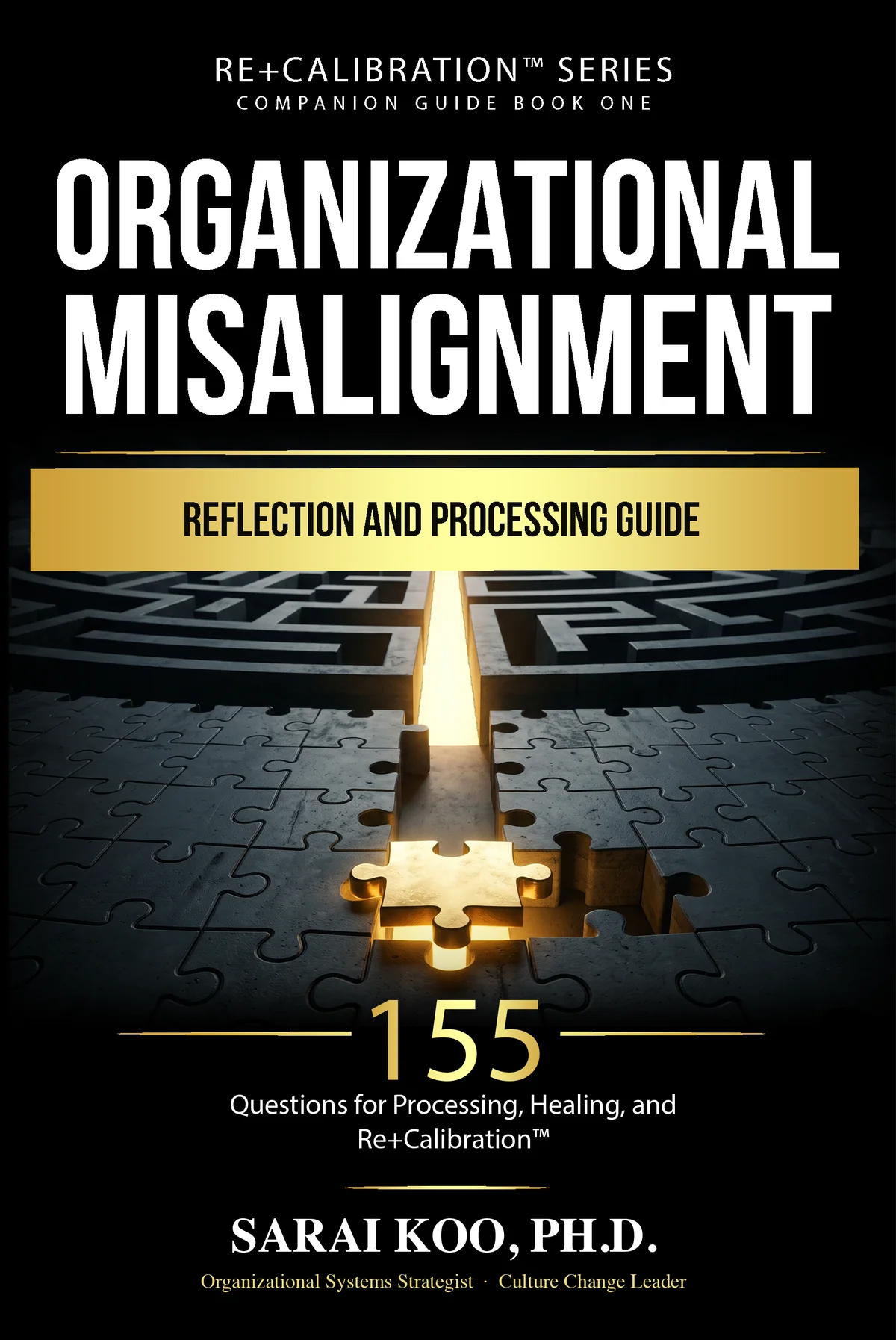
Re+Calibration™ Series · Book One
155 Leadership Behaviors That Damage Trust, Culture, and Performance
Organizational Misalignment turns vague organizational dysfunction into recognizable patterns that can be examined rather than simply endured. It gives employees, leaders, HR professionals, and decision-makers the words for what may actually be happening.
The companion Reflection & Processing Guide extends that recognition through 155 questions for processing, healing, and Re+Calibration™.
“Dr. Koo does something rare: she gives precise language to workplace dynamics most of us have felt but could never quite name.”
The Re+Calibration™ Book List
Join the list for release updates on Organizational Misalignment and its companion guide, plus practical leadership insights and workplace-culture resources.
 Explore the book at drsaraikoo.com ↗
Form not loading? Open the book-list form.
Recognize → Understand → Re+Calibrate™
Begin by recognizing the pattern. Then decide how far the conversation needs to go.
Start with Organizational Misalignment and learn to recognize 155 leadership behaviors across five areas that affect trust, culture, communication, accountability, and performance.
A keynote, executive conversation, leadership workshop, assessment, or deeper Organizational Re+Calibration™, starting with a confidential conversation.

Prefer to talk first? Call (888) 305-8884 or email [email protected]
The goal is not to label every difficult workplace interaction as dysfunction. It is to become better able to recognize recurring patterns, understand their impact, and determine what deserves closer examination.
Make patterns visible enough to examine instead of automatically accepting them as normal.
Examine how leadership behavior, relationships, communication, authority, culture, and organizational conditions interact.
Move from awareness toward healthier leadership and organizational conditions.